The Problem with Conventional Hemp Farming
Hemp is a bioaccumulator — a plant that absorbs compounds from its environment and concentrates them in its tissues. This property has made hemp valuable for phytoremediation (cleaning contaminated soil) and has also made it a liability in the supplement industry.
Hemp grown in conventional agricultural soil is exposed to whatever that soil contains: pesticide residues from previous crops, heavy metals from industrial runoff, microbial contaminants, and the accumulated inputs of years of conventional farming. Because hemp concentrates these compounds, a plant grown in compromised soil can produce extract with measurable levels of lead, cadmium, arsenic, and pesticide residues — even if no inputs were applied to the hemp crop itself.
This is not a theoretical concern. Third-party testing of commercially available hemp products has repeatedly found heavy metal contamination, pesticide residues, and microbial contamination in products sold through mainstream retail channels. The FDA's own testing program has found significant discrepancies between labeled and actual CBD content, as well as contaminant levels that would be concerning for regular consumption.
What Aeroponic Cultivation Is
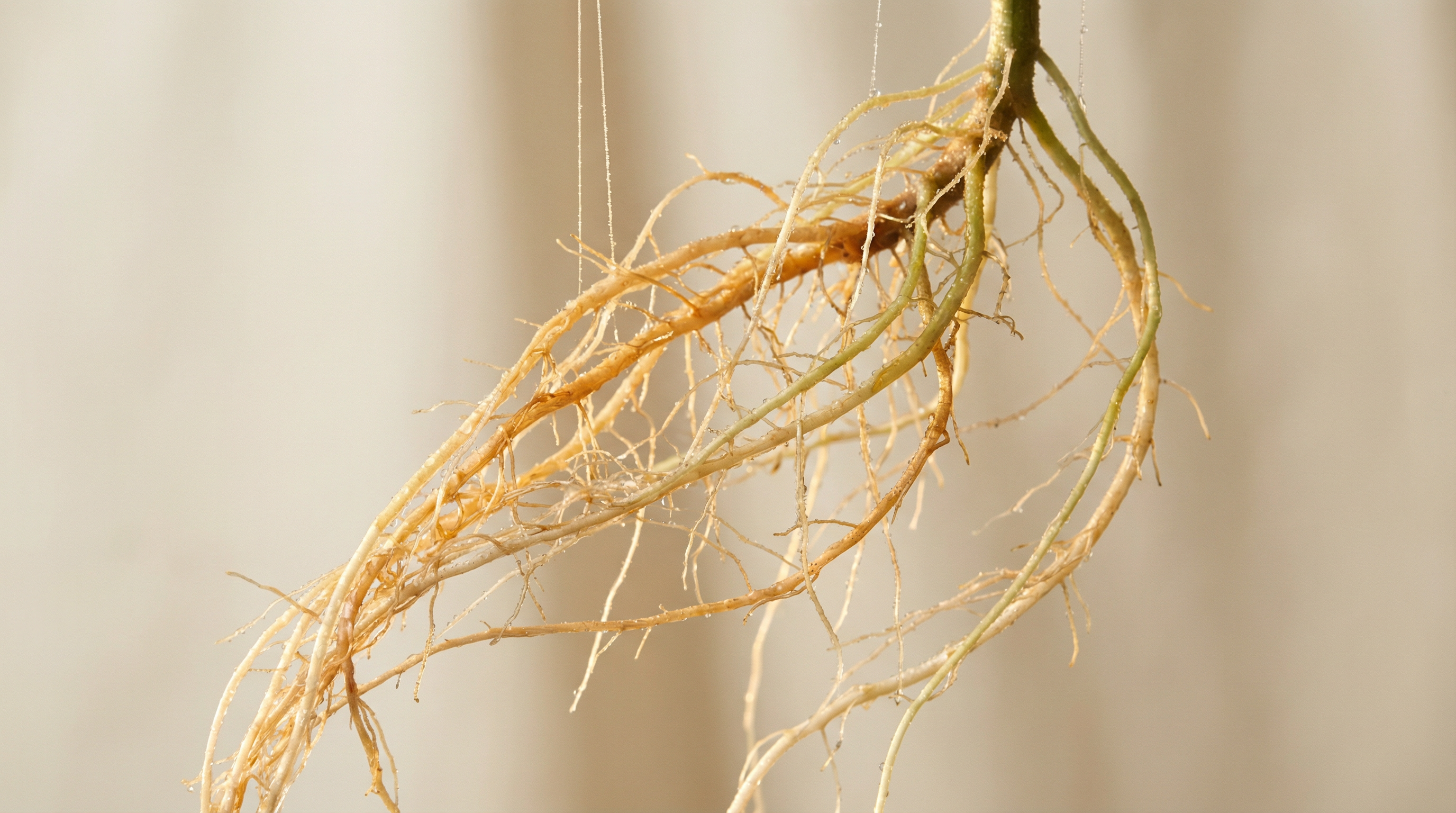
Aeroponic cultivation is a method of growing plants without soil. Plant roots are suspended in an enclosed environment and misted at regular intervals with a precisely formulated nutrient solution. The roots are exposed to air between misting cycles, which dramatically increases oxygen availability compared to soil or hydroponic systems.
The technique was originally developed by NASA for growing food in space — an environment where soil is unavailable and every input must be precisely controlled. It has since been adopted in controlled-environment agriculture for high-value crops including leafy greens, herbs, and increasingly, hemp.
Why Aeroponic Hemp Is Cleaner
The purity advantage of aeroponic cultivation is straightforward: without soil, there is no pathway for soil-borne contaminants to enter the plant.
Heavy metals cannot accumulate in a plant that never contacts metal-containing soil. Soil-borne pesticide residues cannot be absorbed by roots that are never in contact with soil. Soil-borne pathogens (certain bacteria, fungi, and nematodes) cannot infect a root system that exists in a sterile, controlled environment.
The nutrient solution used in aeroponic systems is pharmaceutical-grade and precisely formulated — every input is known and controlled. This creates a traceable, auditable supply chain from nutrient solution to finished plant material that is simply not possible with conventional soil farming.
Why Aeroponic Hemp Is More Potent
Beyond purity, aeroponic cultivation produces measurably higher cannabinoid and terpene concentrations than conventional methods. The mechanism is stress-response biology.
Hemp produces cannabinoids and terpenes as secondary metabolites — compounds that are not directly required for growth but serve protective functions. Cannabinoids and terpenes protect the plant from UV radiation, desiccation, and insect predation. When the plant is under mild environmental stress — slightly elevated temperature, controlled UV exposure, carefully managed nutrient availability — it responds by increasing secondary metabolite production.
Aeroponic systems allow cultivators to precisely dial in these stress parameters. The result is hemp flower with cannabinoid concentrations that can be 30-50% higher than conventionally grown equivalents, with a more robust and consistent terpene profile.
The Consistency Advantage
Perhaps the most underappreciated advantage of aeroponic cultivation is consistency. Soil composition varies across fields, between seasons, and with weather patterns. This variability translates directly into variability in the finished plant material — different cannabinoid ratios, different terpene profiles, different contaminant levels from batch to batch.
Aeroponic systems operate in controlled indoor environments where temperature, humidity, light spectrum, nutrient concentration, and pH are maintained within tight tolerances. The result is hemp that performs consistently from harvest to harvest — which is essential for producing supplements with predictable effects.
What to Look for in a Hemp Brand
When evaluating hemp extract products, the cultivation method is one of the most important quality indicators — and one that is rarely disclosed on product labels.
Questions worth asking:
- Is the hemp grown in the United States under USDA oversight?
- What is the cultivation method — outdoor, greenhouse, or indoor controlled environment?
- Is the source hemp tested for heavy metals, pesticides, and microbials before extraction?
- Are batch-level certificates of analysis available for review?
At Divine Earth Theory, our source hemp is grown aeroponically in controlled indoor environments, tested at multiple stages of production, and processed using our Full Cryosonic Extract™ method to preserve the complete cannabinoid and terpene profile. We believe transparency about sourcing is not optional — it's the foundation of trust.
These statements have not been evaluated by the Food and Drug Administration. This product is not intended to diagnose, treat, cure, or prevent any disease.