By Divine Earth Theory | A Modern Apothecary
There is a fact about hemp that the industry has been slow to reckon with — not because it's hidden, but because acknowledging it honestly requires a better answer than most brands are prepared to offer.
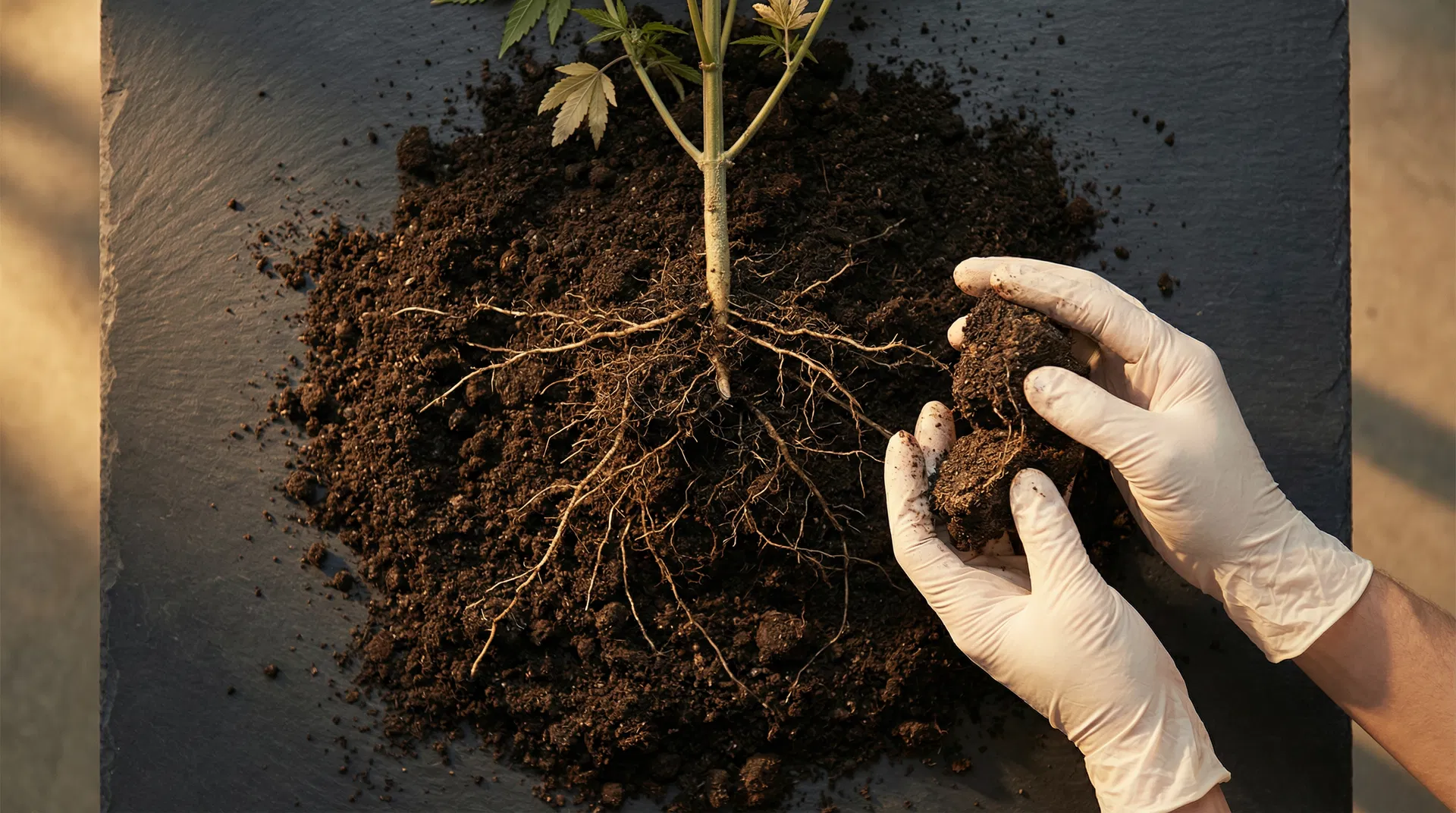
Hemp is a natural bioaccumulator.
It draws substances from its environment — water, nutrients, minerals — and concentrates them in its tissues. This is an extraordinary biological capability. The same mechanism that makes hemp valuable for phytoremediation (the use of plants to clean contaminated soil) also makes the source of your hemp extract one of the most consequential variables in any product's quality.
Because hemp doesn't just absorb the good things. It absorbs everything.
What Bioaccumulation Actually Means
Bioaccumulation refers to a plant's ability to absorb and concentrate substances from its growing environment — soil, water, and air — at levels higher than those found in the surrounding medium. Hemp (Cannabis sativa) is among the most efficient bioaccumulators in the plant kingdom.
This property has been studied and documented extensively. Hemp has been used in post-Chernobyl remediation efforts to extract radioactive cesium and strontium from contaminated soil. It has been studied for its capacity to absorb lead, cadmium, arsenic, nickel, and other heavy metals through root uptake.
This is remarkable science. It is also a direct warning about what can end up in a hemp extract.
When hemp is grown in soil containing pesticide residues, industrial runoff, heavy metals, or synthetic fertilizer compounds — as a significant portion of commercial agricultural land in the United States does — those compounds are drawn into the plant and concentrated in the same resinous tissues that carry cannabinoids, terpenes, and flavonoids.
Standard extraction processes cannot fully separate contaminants from the compounds you actually want. What enters the plant enters the extract.
The Scale of the Problem in Commercial Hemp Cultivation
The 2018 Farm Bill legalized industrial hemp cultivation in the United States, triggering rapid expansion of domestic hemp farming. With that expansion came a challenge that the industry has never fully addressed: the quality and history of the soil.
A significant portion of American hemp is grown in traditional agricultural soil — land with decades of farming history, pesticide applications, and chemical inputs. Some of this land is genuinely clean. Much of it is not.
The issues are compounding:
Pesticide residue. Hemp is an attractive crop for pest pressure — spider mites, aphids, fungus gnats, and thrips are persistent challenges in open-growing environments. Many commercial growers use pesticide applications to manage pest loads. Residues bind at the molecular level to hemp's resinous trichomes — the same structures that produce cannabinoids. Extraction concentrates rather than removes them.
Heavy metals. Agricultural soil — particularly in areas with industrial history — frequently carries elevated levels of heavy metals including lead, cadmium, and arsenic. Hemp's root system is exceptionally effective at drawing these compounds into the plant.
Inconsistent growing conditions. Soil composition, water quality, nutrient availability, and microbial profiles vary widely between farms and even between fields on the same farm. This creates batch-to-batch inconsistency that no amount of downstream processing can fully correct.
Biomass dilution. Traditional hemp cultivation produces large quantities of stalks, leaves, and root matter with minimal cannabinoid content. This low-value biomass is often processed alongside premium flower, diluting potency and introducing additional variability.
Why Third-Party Testing Is Necessary But Not Sufficient
The industry's standard response to this problem is third-party testing: send a sample to a lab, publish a certificate of analysis, and call it solved.
Third-party testing matters. It is a non-negotiable baseline. But it is not the same as addressing the source of the problem.
A certificate of analysis tests a sample — not the entire batch. It identifies the contaminants the lab is testing for — not every possible contaminant. And it provides a snapshot after the fact, rather than preventing contamination from entering the product in the first place.
The only way to genuinely solve the bioaccumulator problem is to eliminate the contamination pathway at the source: grow hemp in an environment where it cannot absorb what it shouldn't.
Aeroponic Cultivation: Addressing the Problem at the Root
Aeroponic cultivation suspends hemp plant roots in air, delivering nutrients and water through a precisely calibrated misting system. The roots never contact soil. There is no accumulated chemical history, no heavy metal uptake pathway, no pesticide residue migration.
The result is categorically different from what soil-based cultivation can offer:
- Zero soil contact eliminates the primary heavy metal and contaminant absorption pathway
- Controlled nutrient delivery means the plant receives exactly what it needs and nothing it doesn't
- Enclosed environment removes the conditions that drive pesticide demand — pest pressure is managed through environmental control rather than chemical application
- Precision growing conditions produce consistent cannabinoid and terpene profiles batch over batch
- 90% less water usage compared to conventional cultivation — restorative by design
NASA studied aeroponic cultivation for growing food in space — precisely because it produces clean, controlled, predictable plant growth in an environment with no margin for error. The same principles that make it valuable for food production make it the most defensible approach to hemp cultivation for therapeutic use.
What "Clean" Actually Means at Scale
It's worth examining what it takes to make a genuine claim of clean hemp — not as a marketing statement, but as a scientifically defensible position.
It requires a growing environment free of soil contamination pathways — not just tested soil, but an environment where soil-based contamination is structurally impossible. It requires zero pesticide application, achieved through environmental control of pest conditions rather than chemical management. It requires controlled water quality, because the water a plant is misted with is as important as the medium it grows in. It requires consistent, documented nutrient profiles so that what the plant is fed is known and controlled throughout every growing cycle. And it requires third-party verification — as confirmation, not as the primary safeguard.
This is not a description of premium soil-grown hemp. It is a description of an entirely different growing paradigm.
The Downstream Impact on Extraction
When you start with a genuinely clean plant, extraction technology can preserve what the plant built rather than managing what it absorbed.
FCE™ Full Cryosonic Extract technology uses low-temperature, low-pressure processing to capture cannabinoids, terpenes, and flavonoids without the heat-induced degradation that characterizes conventional extraction methods. The most fragile compounds in the plant — the acidic cannabinoids like CBDA, the volatile terpenes, the flavonoids that contribute to the entourage effect — are preserved rather than sacrificed to extraction efficiency.
This only works if the source material is clean. No extraction technology can meaningfully separate beneficial compounds from contaminants that have been bioaccumulated at the molecular level into the same trichomes that carry them.
The sequence matters: clean growing environment → whole-plant preservation extraction → advanced delivery technology. Each step depends on the one before it.
What to Ask About Any Hemp Product You're Taking
The bioaccumulator reality should reshape the questions you ask about any CBD or hemp product:
- Where was the hemp grown? Not the state — the growing environment. Outdoor soil? Indoor controlled? Aeroponic?
- What is the soil history of that growing environment? If it's soil-grown, this is a genuinely important question.
- Does the COA test for heavy metals and pesticide residues — not just cannabinoid content?
- Is there batch-to-batch consistency in the COA data, or do potency numbers vary widely?
- What extraction method was used — and at what temperature?
If a brand can't answer these questions, or if the answers reveal a soil-grown product with no heavy metal testing, you're taking a product whose contamination profile is unknown.
The Bottom Line
Hemp's power as a therapeutic plant and its vulnerability as a bioaccumulator are two sides of the same biological coin. The same sensitivity that makes hemp extraordinary in the right conditions makes it a liability in the wrong ones.
The solution isn't better testing downstream. The solution is building a growing system where contamination doesn't enter the plant in the first place — and then doing the extraction and formulation work to honor what that clean plant produces.
This is the problem Divine Earth Theory was built to solve. It starts with the growing environment. Everything else follows.
See our approach in action. Visit The Science to learn how aeroponic cultivation, FCE™ extraction, and micelle delivery work together — and The Journal's Lab Testing page to review our batch-level COA data.
These statements have not been evaluated by the Food and Drug Administration. This product is not intended to diagnose, treat, cure, or prevent any disease. This article is for educational purposes only.
© 2026 Divine Earth Theory LLC